

Quadra Commodities SA (“Quadra”) v XL Insurance Co [2023] EWCA Civ 432 (Court of Appeal)
This is believed to be the first reported case on the statutory right to claim damages for the late payment of an insurance claim. The issue arose in the manner described below.
The issues in the case
The facts – The case involved a grain commodities fraud. The Ukrainian group Agroinvest obtained grain, corn and sunflower seeds from local farmers, which it on-sold to international markets. When the group made a sale, the buyer would pay 80% of the purchase price and Agroinvest would issue the buyer with a receipt for delivery of the goods into its warehouses. Pending physical delivery to the buyer at the seaport, payment of the final 20% and transfer of title, buyers could send surveyors periodically to check and sample the goods. However, the goods as thus sold were not kept separate by Agroinvest, but stored in bulk with other quantities of the same commodity.
One such purchasing trader was Quadra, who declared its purchases from Agroinvest under its marine cargo open policy, which gave cover against misappropriation, amongst other perils.
Agroinvest’s fraud consisted of selling the same goods to numerous different buyers. Obviously, when it came to delivery against the warehouse receipts, there was not enough of the commodity to go round. Agroinvest collapsed, at which point the goods that Quadra had purchased were nowhere to be found. Quadra submitted a claim under its insurance.
The terms of Quadra’s insurance – As to the subject matter of this insurance, Quadra’s “interest” was described as being on,
“goods … and/or … interest of every description incidental to the business of the Assured … consisting principally of but not limited to cereals, grain … and food products in container, bulk and/or break-bulk”.
It is possible to insure against perils adversely affecting a marine “adventure” such as the storage and subsequent carriage of goods by sea, and also against the loss of profits. However, the Commercial Court held that, in the present case, the subject matter of the insurance that Quadra had obtained was simply goods in which Quadra had an insurable interest.
Insurers’ central defence was that, because of the facts of the case, Quadra had no insurable interest in the subject matter insured. The court therefore had to consider the relationship between the subject matter of the insurance (damage to, or loss of, goods) and any insurable interest that Quadra had in that risk.
The court’s decision – The court accepted that the policy would not cover a situation where no goods had existed (because the goods could not then be lost or damaged). Nor did Quadra have any proprietary interest in the goods. However, the court did accept that there would be coverage for misappropriation if (a) there had been goods (b) in which Quadra had an insurable interest.
Even though the evidence partly depended on documentation issued by, and warehouse access controlled by, the fraudulent Agroinvest, the court accepted that Quadra had established, on a balance of probabilities, that goods corresponding to the cargoes they had purchased were sufficiently identified as physically present at the time the warehouse receipts were issued to Quadra.
As to insurable interest, the court held that Quadra had an immediate right to possession of the goods, the insurers not having established that any other party had any rights that would oust Quadra’s rights. The court held further that, as Quadra had rights derivable from “a contract about the property”, on old English authority Quadra did have an insurable interest in the goods. The court was fortified in this conclusion by a US court decision, itself based on English law principles, to the effect that part payment of the purchase price in respect of unascertained goods gave rise to an insurable interest even though the insured did not have a proprietary interest in the goods. Quadra therefore succeeded in its insurance claim (this decision being upheld on appeal).
The claim for damages
Pursuant to s.13A Insurance Act 2015, it is an implied term of every contract of insurance that the insurer must pay any sums due in respect of a claim within a reasonable time. The section makes clear that a reasonable time includes a reasonable time to investigate and assess the claim.
Section 13A states that what is reasonable depends on the circumstances, but (a) the type of insurance, (b) the size and complexity of the claim, (c) compliance with statutory or regulatory rules and guidance and (d) factors outside the insurer’s control, may need to be taken into account. If the insurer shows that there were reasonable grounds for disputing the claim, the insurer does not breach the implied term by failing to pay the claim while the dispute is continuing, but the insurer’s conduct may be relevant.
In the present case, there were some 15 months between the insured giving notice of loss and the commencement of proceedings. Quadra contended that the insurer did not pay sums due to it within a reasonable time, asserting that the insurer’s conduct of the claim was wholly unreasonable and its investigations either unnecessary or unnecessarily slow.
The Commercial Court approached Quadra’ claim for interest by considering two separate questions; (1) What was a reasonable time within which the insurers should have paid the claim? (2) Were there reasonable grounds for disputing the claim, the insurer’s conduct being relevant to this question?
As to the first question, the court held that the burden of proof was on the insured to show that the insurers had taken longer than a reasonable time. In the present case, Quadra offered no expert or comparative evidence. Therefore, the court considered the factors listed alphabetically above. As to (a) the type of insurance was marine cargo. Claims under such covers could involve “very various factual patterns and differing difficulties of investigation”. As to (b), the size and complexity of this claim was substantial, but not exceptional. The fraud, the uncertainty as to what happened at the warehouse and issues concerning the governing law of the insurance were all significant complicating factors. There were no relevant circumstances to consider under factor (c) but as to (d), a number of factors had been outside the insurer’s control, in particular certain local proceedings and the recovery effort in Ukraine. The court concluded that a reasonable time to investigate, evaluate and pay the claim was ‘about a year from the notice of loss’, assuming no reasonable grounds for disputing the claim.
As to the second question, the court held that the insurers did have reasonable grounds for disputing the claim. The fact that the court had found the grounds to be wrong did not indicate that the grounds were not reasonable.
Quadra argued that the issue of the insurers’ conduct should be considered in its own right, and that the insurers’ handling of the claim was unreasonable and too slow. However, the court considered that the insurers’ conduct, for example in the investigations that they made, should not be regarded as a relevant factor because it could not sensibly be distinguished from their grounds, considered reasonable, for disputing the claim. Therefore, the Commercial Court held that Quadra was not entitled to damages. This decision was not the subject of any appeal.
For further information contact Wendy Miles, Chris Earl or William Sturge at Lovetts Solicitors.
BTI 2014 LLC v SEQUANA SA AND OTHERS [2022] UKSC 25
Directors will need to monitor their company’s financial position more closely, following a recent decision of the Supreme Court.
To paraphrase section 214 of the Insolvency Act 1986 relating to wrongful trading, the court may require a contribution to be made to the funds of an insolvent company by a director who, when he ought to have known that the company could not avoid insolvent liquidation, failed to take every reasonable step to minimise the potential loss to creditors.
Further, to paraphrase section 239 of the same Act relating to preferences, the court may require a contribution to be made or a repayment where, within six months prior to the start of insolvency proceedings, at a time when the company had been unable to pay its debts, funds or assets were transferred by a director out of the company with the intention of preferring the recipient over the general class of creditors.
In addition to the statutory provisions referred to above, the Supreme Court has recently decided that the common law fiduciary duty which is owed by directors to their companies, essentially requiring directors to act in good faith in the interests of the company as a whole, can extend beyond considering the interests of shareholders, so as to become a duty to consider the interests of the creditors as a whole (referred in this note as ‘the creditor duty’).
In summary, the duty is to refrain from harming creditors’ interests. The more perilous the financial position, the more onerous the creditor duty becomes. If the creditor duty is breached, the court may, on the application of the company, require the director personally to make good the loss arising.
The type of situation covered by the creditor duty which is not already covered by sections 214 and 239 might typically involve a director of a company which is bordering on insolvency entering into a risky transaction as ‘a last roll of the dice’. The shareholders might have little to lose from such a course, but creditors could be severely prejudiced economically.
The creditor duty has only recently become established and its parameters are still being developed. The Supreme Court’s decision is therefore of considerable importance to directors and their D&O Insurers.
The facts
In May 2009, AWA distributed a dividend of €135m to its only shareholder, Sequana SA, thereby discharging some intra-group liability. This payment was lawful in that it complied with the regulations governing dividends contained in Part 23 of the Companies Act 2006 and with rules relating to capital maintenance. AWA was at the time unquestionably solvent on both a balance sheet and a cash flow basis.
However, AWA had long term pollution-related contingent liabilities of a very uncertain amount. The company had made provision for these in its accounts albeit that there was uncertainty as to the value of one class of its assets (insurance). This gave rise to a real risk, although not a probability, that AWA might become insolvent at an uncertain but not imminent date in the future.
Subsequently, BTI 2014 LLC, as assignee of AWA, brought proceedings claiming that the directors who had authorised the dividend had acted in breach of their duty to have regard to the interests of AWA’s creditors.
Finally in 2018, some nine years after the dividend was paid, AWA entered insolvent administration.
The decision
BTI’s case was that the creditor duty had arisen by the date of the dividend distribution because by then there was a real and not remote risk that AWA may in the future become insolvent.
However, the Supreme Court found in favour of the directors and held that, by the date of the distribution, the creditor duty had not yet arisen.
In order to reach their decision, the judges of the Supreme Court considered the justification for the creditor duty and made provisional findings as to what it consists of and when it arises. Their findings are summarised as follows.
Position prior to insolvent liquidation being probable – It is to be noted that liability for wrongful trading under section 214 only arises when there is a subsequent insolvent liquidation. The rationale for this restriction be may that creditors are not the main stakeholders at any earlier stage than when the company enters insolvent liquidation. It is the prospect of insolvent liquidation, in which creditors will have an economic interest in the sense of a right to receive a distribution of the assets of the insolvent estate, that entitles creditors to have their interests considered earlier, when liquidation appears likely.
Prior to insolvent liquidation appearing likely and as the present case illustrates, there may be a lengthy period and a major difference between a company being subject to a real risk of insolvency on the one hand, and probable or imminent insolvent liquidation on the other. Insolvency may be temporary and there may genuinely be light at the end of the tunnel. For example, many start-up companies may be in this position. Applying these and other considerations, the Court held that the existence of a real risk of insolvency is too far removed from the liquidation process to give rise to the creditor duty.
Position when insolvent liquidation is probable, albeit the situation is not necessarily irretrievable – The content of the creditor duty at this stage is to consider creditors’ interests, to give these appropriate weight, and to balance the creditors’ interests against shareholders’ interests where they may conflict. The evaluation thus undertaken is likely to be highly fact-sensitive.
As to when the creditor duty arises, a majority of the Court considered that this would be either on ‘imminent’ insolvency (i.e. an insolvency which directors know or ought to know is just round the corner and going to happen) or when there is the ‘probability’ of an insolvent liquidation ‘about which the directors know or ought to know’. Another formulation is when the company is ‘bordering on insolvency’. There are also different ways of defining the term ‘insolvency’ itself, as the case may require.
Position where insolvent liquidation is inevitable – Here the economic interest lies with the creditors. The interests of shareholders cease to carry any weight and the company’s interests have to be treated as equivalent to the interests of its creditors as a whole. That gives rise to the duty to treat the interests of creditors as paramount.
Limits on the principle of ratification – Shareholders have the power to authorise or ratify acts committed by directors in breach of their duties as long as these are within the powers of the company. However, the Court held that this principle applies only to solvent companies.
Lovetts’ Comment
This case is helpful in clarifying numerous aspects of the creditor duty. However, there may be some difficult judgment calls for directors in determining when a company is ‘bordering on insolvency’ or when insolvent liquidation is ‘imminent’ or ‘probable’ and therefore when directors become subject to the creditor duty. Directors will need to monitor their company’s financial position and prospects with care, take professional advice when necessary and make a careful record of their assumptions and decisions.
For further information, please contact Wendy Miles, Chris Earl or William Sturge at Lovetts.
Lovetts online client portal, CaseManager is a unique case management portal which allows a client to have complete control over the debt recovery process. CaseManager allows clients to instruct Lovetts Solicitors and view their cases 24/7. To ensure CaseManager remains a market leading client portal for debt recovery, Lovetts is continually looking to enhance and develop it. Accordingly, Lovetts recently sent out a client satisfaction survey in order to gather our clients valuable feedback.
The results of the survey are detailed below and the feedback will enable Lovetts to provide our clients with the features and updates that they want to see. At Lovetts we want to make the debt recovery process as simple and stress free as possible. Accordingly 60% of clients that took part in the survey rated CaseManager’s ease of use either 4 or 5 stars out of 5.
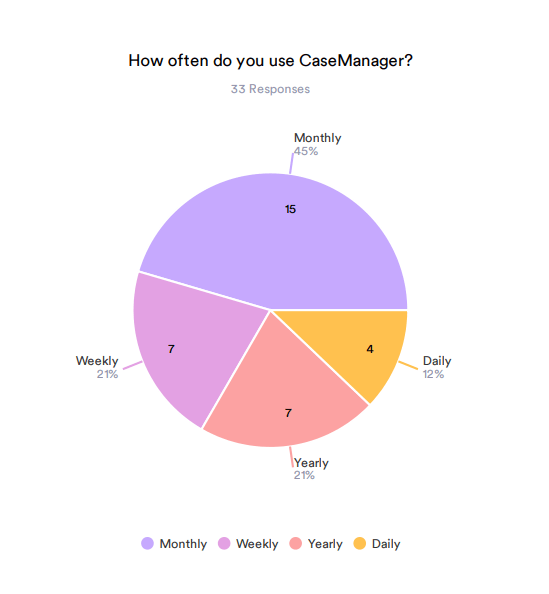
66% of clients said they check case information either every time or most times that they login to CaseManager. With the remaining 33% saying they sometimes check case information. For us, this shows that this functionality is really useful and is time effective for both the client and for Lovetts as clients can simply login to their account and have their case information within seconds.
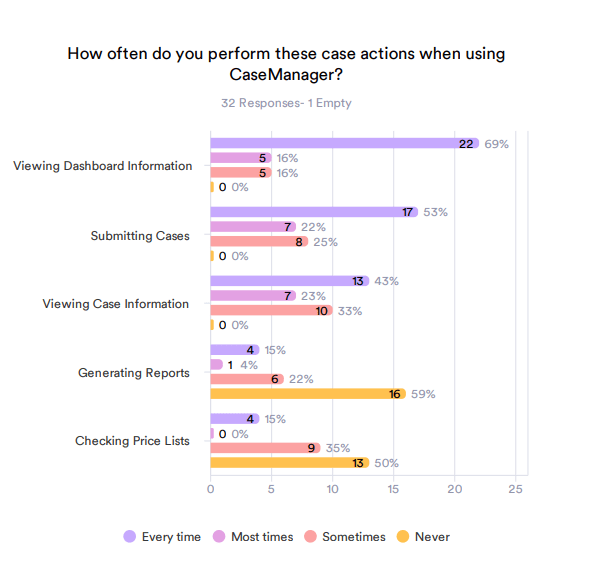
On the flip side we can see that 79% of clients that took part in the survey said that they never view auditing information or search for legal resources. Therefore this is something that we may look to remove.
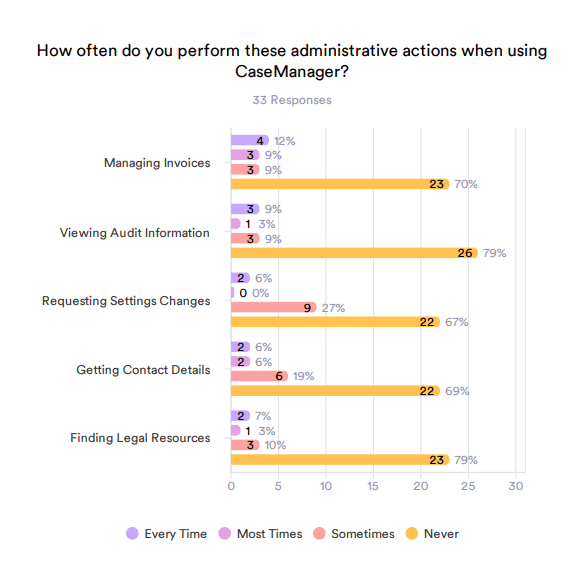
Most of our clients (75%) told us that they use CaseManager either daily, weekly or monthly with the remaining 25% using CaseManager yearly. CaseManager is so useful for many different reasons, not just instructing us on a case. Clients are able to check the status of cases, run reports, make changes/updates to their account and much more on CaseManager at any point in the day. Therefore, this result is assuring to see as we can imply that the information provided on their is useful for clients.
We would like to say a huge thank you to all of the clients that took part in our survey and allowed us to gather some valuable information which can be used to improve your CaseManager experience.
For every survey completed, Lovetts donated £2 to Oakleaf, which is a mental health charity Lovetts supports. They carry out fantastic work and Lovetts would like to thank all the clients that participated in the survey.
If you have any questions above the above please do not hesitate to contact us at [email protected]
We are delighted to share that we will be extending our sponsorship with Woking FC into the 2022/23 season.
Lovetts have been huge supporters of Woking for many seasons now and so the decision to extend was an easy one. We are looking forward to supporting the club moving forward both on and off the pitch. With the announcement of new manager Darren Sarll we are optimistic that Woking will continue to make significant progress on and off the pitch.
Woking FC’s commercial Director Mick Livsey comments –
“It is such great news that Lovetts Solicitors have signed up for the 2022/23 season with an increased package,”
“From the moment I sat down with Managing Director Michael Higgins it was apparent we shared so much passion for the Football Club and the community of Woking.
“It is our desire to build very special relationships with the business community and this is one such relationship, a huge thank you to Michael and everyone connected with Lovetts Solicitors.” Livesey added.
Lovetts are continuously working on ways on which we can support our local community and businesses within it. Along with our sponsorship at Woking FC we will work to continue our support at Oakleaf. Oakleaf is a mental health charity based in Guildford. They do amazing work to support their clients in the community with their mental health, providing a safe haven and supporting their clients return to work.
The FSB Awards have been designed to celebrate achievements of small businesses and self-employed personnel across the UK. In a range of different categories, winners from the South East region go on to secure a spot in the UK final.
This year Lovetts Solicitors were the proud sponsors of the Environmental Business of the Year award in the South East category. Lovetts chose to sponsor this particular category because it believes sustainability and protecting the environment is essential. As a Planet Mark Certified business, Lovetts are committed to the continuous improvement and reduction of its carbon footprint. In doing so Lovetts has looked into ways it can reduce its food waste along with utilising a working from home routine through lock down which has allowed Lovetts to reduce its greenhouse gases.
Lovetts Client Services and Digital Marketing Executive; Amy Tilley was the judge for this category. Amy is heavily involved within the marketing at Lovetts and assists with client take on. Within her role she has learnt a lot about Planet Mark and been involved in suggestions from other team members for ways in which we, as a business, can be more environmentally friendly.
After asking Amy how she found judging this category she said –
“I thoroughly enjoyed taking part in being a judge for this category as part of the FSB awards. It was amazing to see and to learn different ways in which businesses from all different industries are able to become more and produce environmentally friendly products/resources. Every SME that entered has something different and special to offer.”
“I chose Puremess as the winner, a natural and sustainable skincare range. Puremess utilize local suppliers and use biodegradable, reusable, recyclable or refillable packaging. For every delivery made a tree is planted and delivery is made using a hybrid car. Their business ethos stood out to me because I could sense the deep rooted passion for the work they did through their video and website content. Their application represented a wholesome business that wanted to make a real positive impact on the environment through their sustainable packaging and all natural skincare range.”
If you would like to learn more about Puremess you can visit their website here.
From everyone at Lovetts, a huge congratulations to all of the winners and good luck in the final which will take place in Glasgow, later this year.
UK & International Debt Recovery specialists, Lovetts Solicitors are pleased to announce that they are a founding member of Oakleaf’s Mental Health Leaders Network.
In recent months, Oakleaf launched a new network of Mental Health Leaders. Lovetts has had the pleasure of being a founding member along with several other companies whom have a shared commitment to continuous improvement of workplace mental health. Although this is predominantly with regards to workplace mental health, at Lovetts we are hopeful that our team can take away skills that can be used outside the workplace as well.
Oakleaf are a mental health charity, based in Guildford. Oakleaf provide work-related training, wellbeing activities and counselling services to their clients with the aim to boost confidence and reshape their lives subsequently improving their mental health. These activities all help to assist with teaching ways in which you can manage your mental health in the future. Oakleaf have continued to work throughout the pandemic to minimise self-isolation. They are currently supporting in excess of 375 individuals to adopt confidence and a sense of empowerment.
The Mental Health Leaders Network has been created with the aim of bringing businesses in Surrey together who have the shared desire to improve the mental wellbeing of their employees as well as being committed to supporting Oakleaf. Benefits of joining the network include gaining an abundance of knowledge from not only Oakleaf but other businesses and how they have, first hand, dealt with different situations that we ourselves may not have experienced. It is a great opportunity to network, raise awareness and make a difference within the local community.
Within the network there are 13 founding members with plans to expand without reaching a capacity to where the core values become clouded. We will have quarterly meetings whereby we have an expert talk, discussions with other members and take part in activities where we will have the opportunity to learn and develop our existing skills that relate to assisting with workplace mental health. Specific mental health issues such as depression, stigma, suicide, anxiety and many more will be covered in virtual sessions that we will have the option to take part in.
Detailed in Deloitte’s 2020 case refreshment of the Stevenson-Farmer review we were able to learn that only 9% of employees that were surveyed, and 13% of all managers, have attended training that focused solely on mental health. This follows that 62% of managers said that they have had to put the interests of their organisation above their staff wellbeing either sometimes, regularly or everyday.
To learn more about the Mental Health Leaders Network and how you can join to become a member, Oakleaf have a page dedicated on their website which has, enclosed, all of the details. Click here.
We’re proud to announce that we’ve achieved the Planet Mark 2021 Business Certification. This is an incredible achievement involving the entire business.
The Planet Mark Business Certification is an internationally recognised sustainability certification for business acknowledging continuous progress, encouraging action and building an empowered community of like-minded individuals.
In this crucial Decade of Action, measuring our own carbon footprint has been a critical step in reducing our impact on the planet and society.
Through Planet Mark we have protected an area of endangered rainforest thanks to Cool Earth; a charity working alongside rainforest communities to halt deforestation. Our pledge through Cool Earth goes directly towards supporting the Asháninka community in Central Peru.
Through our commitment to Planet Mark we are also helping the Eden Project – an educational charity building connections with each other and the living world, exploring how we can work together towards a better future.
We want to continue to have a positive impact through our business and hope that we can empower our community to take climate action. We hope that you will join us in this movement for change.
Each and every one of you has contributed to our achievement in becoming Planet Mark certified, and will continue to play an important role in our sustainability commitment.
We encourage you to get in touch if you have any questions or suggestions you’d like to share with us, or to join us on this exciting journey of sustainability. Together, we are a collective force for good.
Lexcel is a Law Society legal practice quality mark for client care with only 15% of law firms achieving this accreditation. Lexcel accreditation ensures that law firms act to the highest standards and it endorses excellence in legal practice management.
Every three years Lovetts receive a full audit to obtain Lexcel re-accreditation. Lovetts successfully obtained re-accreditation in September 2021 with the report finding zero non-compliances.
Roger Newman, our Lexcel assessor said:
“For the second year in succession the Lexcel Review of Lovetts Ltd has identified zero non-compliances. The Lexcel Review found a very high standard of file management, and no non-compliances. This is testament to the high quality technology that is employed by the firm, and high standards that are routinely deployed by people in all areas covered by the Lexcel Standard. Staff are highly competent and the systems well designed and implemented.”
Part of the Lexcel assessment requires Lovetts to send out a Client Satisfaction Survey to our clients in order to obtain their feedback and determine what we are doing well along with identifying if there are any areas for improvement. Within our Client Satisfaction Survey, we asked our clients:
1. How helpful have you found Lovetts staff? In response we found that 53% of clients said they found our staff to be extremely helpful, closely followed by 33% of clients who answered very helpful. We had zero responses to being not helpful at all.
2. How quickly do Lovetts staff follow up on your requests? Here we found 86% of clients said that we were either very quick or extremely quick. Again, with no clients saying that we were not quick at all.
3. How user friendly do you find Lovetts online portal; CaseManager? CaseManager is an online portal that allows our clients to have 24/7 access to their cases. Clients can instruct us on new and existing cases as well as being able to view historic cases for the past two years. This enables us to put the control of the legal process into our client’s hands.
We found that 51% of staff found CaseManager very user-friendly and only 3% said that it was slightly user-friendly.
4. How easy is it to understand the information on CaseManager? 35% of Lovetts clients told us that it was extremely easy to understand. 21% said it was somewhat easy, 3% said not so easy and 0% said not easy at all. The majority of clients said that it was very easy to understand the information provided on CaseManager. Clients have a dedicated account executive whom they can contact for further support with their cases. Lovetts staff are always a phone call or an email away for staff to get in contact should they have any queries with regards to their cases or information on CaseManager.
5. How visually appealing is Lovetts client website; CaseManager? We learnt that 5% of clients that took part in our survey said that CaseManager was either slightly or not appealing at all. A majority, 84% voted that it was either somewhat, very or extremely appealing.
6. How much do you trust the information provided on CaseManager? We saw 60% of clients selected that the information on CaseManager is extremely trustworthy and 0% voted that it was either slightly or not trustworthy. It is imperative for us to be transparent with our clients and provide them with valid information.
7. How can we improve CaseManager? For this question we gave clients the opportunity to fill the space with their thoughts. Some feedback we obtained included:
‘We are extremely happy will all the services we have used via LOVETTS case manager portal online. Even with a visual disability, I can clearly navigate my way around their website.’
‘We are totally satisfied with the services we have received.’
‘Only thing I can think of is standard descriptions in the document history to give a better idea of what the document might be.’
At Lovetts we are committed to continuous improvement to ensure our clients are able to receive the best quality and services possible. We are delighted to read that our online portal is able to be used by everyone including those that are visually impaired. Our clients’ needs always come first so we will always welcome suggestions for improvement.
8. How satisfied are you with Lovetts Service? We are delighted to say that 89% of clients that took part in our satisfaction survey said that they were either very or extremely satisfied with our service. We take great pride, at Lovetts, in making sure that our clients come first and that they receive the best service possible. Hence why we dedicate each client their own executive who they can contact should they need any help and ensure they have complete control over their cases via CaseManager.
9. Would you recommend Lovetts to others? 94% said that they would recommend Lovetts which is very rewarding.
10. Do you have any comments, questions or concerns? Responses we received here were as outlined:
‘In particular X is extremely helpful and efficient. She answers all my queries promptly and professionally and is always very knowledgeable and puts it across in a way that I can understand, knowing I don’t come from a Legal background.’
‘In the 11 years + I have dealt with Lovetts I have always been extremely satisfied with the work they have done on my behalf’.
‘Keep up the great work’
The client satisfaction survey allows us to gage an understanding of if/where we need to make improvements in order to meet our client’s needs and make the debt recovery process as painless and stress free as possible.
Lovetts Managing Director, Michael Higgins explains why Lexcel is so important to Lovetts
“Lexcel is important to our business because it gives reassurance to our clients and prospects that we work to the highest standards. To receive zero non-compliances is an incredible achievement and credit goes to the Lovetts staff. It was particularly pleasing to receive praise for our IT systems which allows us to deal with a high volume of cases whilst maintaining a fast and efficient service to our clients.”
For every survey that we completed, Lovetts donated £2 to Oakleaf; a mental health charity that we support. Oakleaf do amazing work to support people with their mental health and provide a safe and comfortable environment for their clients to come and seek support.
Lovetts Solicitors has received positive results from its Client Satisfaction Survey. Lovetts clients range from FTSE 100 companies through to SMEs. The feedback confirmed that 94% of companies would recommend Lovetts Solicitors for debt recovery.
Lovetts is committed to providing its customers with the best service and quality. In line with its commitment to continuous improvement, Lovetts looked to examine its current performance across some issues that are critical to our success.
The best way to do this was by asking its clients to participate in a Client Satisfaction Survey. The survey was completed online. As you can see below, there was a high level of satisfaction.

89% of clients were either extremely satisfied or very satisfied with Lovetts service.

Every client receives a dedicated Account Executive that is responsible for their cases. Our clients can contact this account executive to discuss their cases whenever they wish. 86% of clients found staff either extremely helpful or very helpful.

In our experience, speed is the key to debt recovery. If clients instruct us to send a letter before action (LBA) or issue a claim before 2pm we guarantee it will be sent the same day. 86% of our clients found that Lovetts follow up on requests was either extremely quick or very quick.

As mentioned above, 94% of clients would recommend Lovetts Solicitors to others in respect of recovering business debts.

Lovetts CaseManager is a unique online case management portal providing debt recovery software that puts control of the legal process back into our clients hands. CaseManager is so comprehensive that our clients can manage an entire case using only this system. It was pleasing to find that 82% of clients found CaseManager to be extremely or very user friendly.
Lovetts Managing Director, Michael Higgins, said
“These are really positive results. For over 25 years we have been determined to provide an excellent service for our client. Speed is key and we seek to be as transparent as possible through the use of our client portal CaseManager. Credit goes to all the Lovetts staff who work extremely hard and pride themselves on building great relationships with the clients.”
For every survey completed, Lovetts donated £2 to Oakleaf, which is a mental health charity Lovetts supports. They carry out fantastic work and Lovetts would like to thank all the clients that participated in the survey.
Lovetts Solicitors is furthering its sustainability commitment by becoming Planet Mark certified through measuring and reducing its carbon footprint.
Planet Mark is an internationally recognised sustainability certification for every type of organisation, for real estate and for products. A Planet Mark certification recognises continuous improvement, encourages action and builds an empowered community of like-minded individuals who make a world of difference.
In this crucial Decade of Action, Lovetts want to ensure that it is a force for good: positively transforming society and the planet by measuring its own impact on the environment.
Over the next year Lovetts will be working towards reducing our carbon emissions, and we want to share this journey with our community to encourage others to join us.
Through Planet Mark we are protecting an area of endangered rainforest thanks to Cool Earth; a charity working alongside rainforest communities to halt deforestation. Our pledge through Cool Earth goes directly towards supporting the Asháninka community in Central Peru.
Through our commitment to Planet Mark we are also helping the Eden Project – an educational charity building connections with each other and the living world, exploring how we can work together towards a better future.
Each and every one of you plays an important role in our sustainability commitments, and Planet Mark will help to embed sustainability in our business culture so that we can make continual progress.
We look forward to sharing our sustainability achievements with the wider community as we progress with our plan.