


William Sturge, a leading insurance industry lawyer, has joined Lovetts Solicitors as a Consultant Solicitor from Carter Perry Bailey LLP.
Since qualifying as a Solicitor in 1984, William has become one of the leading solicitors in the insurance industry. He has advised on insurance and reinsurance claims on behalf of reinsurers, reinsureds and their insureds, both in the UK and worldwide. He has conducted insurance and reinsurance litigation and arbitration, acted in professional indemnity and financial lines business and in shipping and international trade disputes. William has also provided non-contentious insurance and reinsurance advice, usually with an international context.
Michael Higgins, Managing Director of Lovetts Solicitors says:
“There is a growing appreciation that it is possible to find City-quality work outside the City, at a competitive price. William is a fantastic addition to the Lovetts team. He has a wealth of experience and allows Lovetts to cement its reputation as a firm that can cater to our client’s needs no matter what industry they operate in.”
William has regularly advised on insurance law issues arising out of insolvency situations. William has also acted as an expert witness in overseas proceedings involving issues of English insurance law.
William Sturge explains why he joined Lovetts Solicitors:
“Lovetts excels in dynamic, tough, no-nonsense efficient and cost-effective legal work, carried on by a top-quality and very experienced team. I am looking forward to integrating my practice into this superb operation and building on the firm’s dispute resolution credentials.”
William has been recommended in the field of insurance, reinsurance and professional negligence by Legal 500 and ranked as a Leading Lawyer in the field of reinsurance by Chambers Guide to the UK Legal Profession. William is also a member of the Chartered Insurance Institute and is qualified in Australia (NSW).
If you have any issues relating to any of the areas of law detailed above, feel free to contact William by email at [email protected] or call 01483 457500.
From 1st October 2021, there will be significant changes to Winding Up petitions. This article will explore the changes in further detail but in summary, Creditors will only be able to issue Winding Up petitions for debts over £10,000 and they will need to give a 21 day notice to debtors before issuing a petition. Further, Creditors chasing commercial rent arrears will be prevented from issuing a Winding Up petition.
Creditors face 4 conditions that they must satisfy before issuing a Winding Up petition. These are:
Condition 1: the debt owed; (a) is for a liquidated amount; (b) has fallen due for payment; and (c) is not rent or any other payments i.e. service charges that are due under a business tenancy agreement;
Condition 2: the creditor has delivered a written notice which states (a) that the creditor is seeking the company’s proposal for the payment of the debt; and (b) that if no satisfactory proposal is made within 21 days of the date of delivery of the notice then the creditor intends to petition for the company’s winding-up;
Condition 3: 21 days have passed since Condition 2 Notice was delivered and the company has not made a satisfactory proposal for the payment of the debt; and
Condition 4: the debt owed to the petitioning creditor (provided they have all met Conditions 1 to 3) is at least £10,000.
Since June 2020, the Corporate Insolvency and Governance Act 2020 meant creditors were essentially prevented from issuing Winding Up petitions against debtors unless that Covid-19 did not have a financial effect on the company; or that the company would have been unable to pay its debts even if Covid-19 had had a financial effect on the company.
The changes from 1st October are seen as an ease on restrictions but the debt threshold for issuing a petition now increases from £750 to £10,000 and there is now arbitrary requirement to issue a 21 day notice, despite there being no obligation for a creditor to accept a payment proposal. These arbitrary barriers to recovering payment from customers failing pay their debts may have a significant impact on the cash flow of a creditor. In particular, it is a devastating blow to creditors pursing commercial rent arrears who are prevented from issuing a winding up petition completely.
These Winding Up petition changes are due to run from 1st October 2021 and end on 31st March 2022 as it currently stands.
Lovetts Solicitors will be providing a service where they enclose a Draft Winding Up petition with the 21 day notice sent to a debtor. In our experience, 81% of cases will result in payment where a draft winding up petition has been sent.
For further information, email [email protected] or call us on 01483 457500.
Despite Court fees having recently increased in May 2021, a further increase in Court fees have been proposed in a blow to Civil Court users.
Creditors seeking to recover debts will see an increase in application fees, hearing fees, enforcement fees and fees relating to insolvency proceedings. A full list of Civil Court fee increases are set out in the Government response from page 43.
Rob Thompson, the Chair of the Civil Court Users Association, stated:
“Unsurprisingly, the CCUA’s calls for a full review of the fee charging structure have again been refused and the latest increase will now be going ahead.
They (the Government) continue to essentially rely on their mantra that the service costs more than the fees which are generated. This is despite the fact that we have continually pointed out that based on their own figures, the civil courts actually generate a considerable profit at the court user’s expense.”
The Court Fee increase is blow to Creditors already facing cash flow issues due to non-payment of debts. In response to the Court fee increase, Michael Higgins, Managing Director of Lovetts Solicitors and Guildways, says:
“Creditors have been facing a raw deal for a long time. The Government have seen fit to increase Court fees twice in the matter of months but fixed recoverable costs for issuing Court proceedings have not seen an increase for over 20 years.
In addition, Civil Court users are funding the Court service but are faced with a poor service and long delays. This needs to change.”
The Statutory Instrument in relation to the increase of Court fees was laid before Parliament on Monday 6 September 2021. Subject to Parliamentary procedure, the Statutory Instrument will come into force at 00:01 on Thursday 30th September 2021. It will result in an immediate increase in 128 fees, covering civil, family, magistrates’ courts, and the Court of Protection.
Boris Johnson isn’t alone in having a County Court Judgment (known as a CCJ) against his name – according to figures from Registry Trust, the agency that records information about County Court Judgments, over 250,000 CCJs were recorded against UK individuals in the first quarter of 2021.
But what is a County Court Judgment and what does it mean? Almost all CCJs are money judgments, which means that one party (the debtor) owes money to another (the creditor), either as a result of a loan or other credit agreement which was not paid back on time, or because money was paid for goods or services which were not delivered or carried out. In these circumstances the creditor can go to court to issue a Claim against the debtor, requiring the money to be repaid.
If the Claim is ignored, or is unsuccessfully defended, then a County Court Judgment will be entered against the debtor. All Judgments are entered onto a central register which is managed by Registry Trust on behalf of the Government, and will stay on the register for six years. All the main credit reference agencies have access to the register and will use the presence of a CCJ as one of the factors when calculating credit scores. This is why people are warned that a Judgment may affect their credit rating, which in turn could make it harder to borrow money in the future, take out a mortgage, open a bank account or carry out a number of other services. The register is open, meaning that any other individual or business can also look up details of a CCJ for a small fee.
So what does this mean for Boris? Well, assuming that the Judgment has not been entered in error then the main thing is that more than 30 days have passed since the Judgment was registered. This is significant because if a Judgment is paid off in full within 30 days the debtor can apply to have the CCJ completely removed from the register as if it had never been entered. However after 30 days, even if the Judgment is subsequently paid in full, the details will remain on the register for six years and will continue to affect credit ratings for that time.
Michael Higgins, Managing Director of Lovetts Solicitors, who specialise in issuing claims and entering Judgments on behalf of their clients who are owed monies, commented “It is unusual for a high profile individual to allow a matter such as this to progress for so long. Even if he was personally unaware of court proceedings, once the Judgment was registered he should have taken prompt action to settle the matter and either have the Judgment settled or, if it was registered in error, applied to the Court to have the Judgment set aside whilst the matter was investigated.”
Notes to Editors
Lovetts Solicitors are the leading specialists in commercial debt recovery. Founded in 1994 exclusively to carry out debt recovery and contract litigation services their clients range from sole traders to FTSE 100 corporations. They are a member of the County Court Users Association and one of the largest issuers of County Court Claims for business debts in the UK. If further comment is required, contact 01483 457500 or email [email protected]
Enforcing judgments after Brexit
Arguably the defining political event of recent years, the United Kingdom officially left the European Union on the 31st of January 2020. After a turbulent year of transition Brexit continues to dominate headlines as more causes for concern are flagged with each passing day. For political commentators the negotiations made for fascinating viewing but for businesses wishing to pursue debts against European customers the reality is far more daunting.
More than anything, Brexit exposed the piecemeal nature of international legislation. Even during 2020’s transition period experts found themselves lost within the labyrinthine set of quasi-applicable acts, agreements, and conventions. For business owners this just brings more to worry about in a time where such things are abundant. Nevertheless, it is important to understand the current status of post Brexit UK court judgments and the ability for businesses to enforce them when seeking to recover debts from European customers.
As detailed in this article, businesses must take steps to protect themselves if they intend to continue trade with customers based within the EU.
Jurisdiction Clauses
Prior to Brexit you would be forgiven for skimming over the jurisdiction clause of a recently drafted contract. Given the easily applied legislation at the time, many considered dispute resolution clauses as rather boilerplate. However, with the UK having exited from the EU, a defined jurisdiction can be crucial in ensuring you can issue court proceedings. Even if you are successful in court, without careful consideration of jurisdiction you may find it incredibly difficult to enforce your judgment.
When drafting a jurisdiction clause in a contract there are three options. First, an exclusive clause which provides that any disputes arising from the agreement can only be settled in whichever courts are stated. Second, a non-exclusive clause gives a little more leeway, meaning the proceedings will initially be heard in the stated jurisdiction but can be relocated if necessary. Finally, a hybrid/asymmetric clause essentially means that jurisdiction for one party is exclusive while for the other it is not. This is usually found in contracts where there is a noticeable imbalance of power, such as when a bank loans money to an individual.
The Brexit Effect
A cause of much concern, however, is the lack of provisions regarding jurisdictional clauses or the enforcement of court judgments in the Britain-EU trade agreement (TCA). A variety of agreements that govern the EU (such as the Lugano Convention or the Recast Brussels Regulation) no longer apply to the United Kingdom. As such, English court judgments are now very difficult to enforce internationally without an exclusive English jurisdiction clause.
If you have an English Jurisdiction clause, you can rely on the Hague Convention. The Hague Convention is a structured set of rules for business-to-business legal matters currently recognised and ratified by the EU, Britain, and a handful of other states across the globe. It states that judgments issued by courts with exclusive handling of the case must be recognised across the signatory states. As Britain has ratified the Convention in its own right, there is a theoretical return to the status quo with the EU. A full list of countries signed up to the Hague Convention can be found on their website at https://www.hcch.net/en/instruments/conventions/status-table/?cid=29
The other major legislative structure in play is the 2007 Lugano Convention. The principles of the Convention are similar to the Recast Brussels Regulation and allow the enforcement of many civil matters across the entire EU as well as many of the EFTA states. The UK has applied to accede to the Lugano Convention, however as of March 2021 they have not received the unanimous approval that they require. As this was not a negotiated aspect of the Withdrawal Agreement, the future of this accession is extremely uncertain.
Post-2021 Implications
Due to the fact that the UK is not currently part of the Lugano Convention, businesses can only rely on the Hague Convention. As mentioned above, the Convention provides that where there is a contractual exclusive jurisdiction clause, judgments entered by an English court are enforceable through the EU. However, if your business does not have an exclusive jurisdiction clause, any UK judgment against a customer based in Europe is not directly enforceable. In essence you may be faced with a Judgment that is not worth the paper it is written on.
The current alternative is to issue court proceedings in the courts of the country where your customer is based. This is likely to be an extremely long and costly process, therefore it is imperative that you look at adding exclusive jurisdiction clauses into your terms of business if you have not already done so.
Conclusions
The disruption of the legislative process arising from Brexit has led to concerns over its patchwork implementation. Many businesses are feeling in the dark regarding their legal standing, especially given the lack of attention given to structures such as the Lugano Convention during the years of negotiations.
However, enforcing judgments post-Brexit is not as doomed a venture as it may seem. While the stress of Brexit may make further business deals seem a daunting ordeal, an exclusive jurisdiction clause will give your business protection and make it easier to recovery debts and secure payments quicker and more cost effectively.
Lovetts Solicitors has recently launched Guildways, a UK and International pre-legal debt collection service. As a no-collection, no fee service for use before legal proceedings are initiated, it complements Lovetts’ fixed fee legal services, and gives flexibility to credit managers both in collection methods and pricing.
It comes at a time where companies are suffering huge pressure on staff, on supplies, on sales fulfilment, and on cash and margins. There is also the looming spectre of Covid-19 Government support ceasing shortly, just when the business world is trying to get back onto its feet.
Chairman Charles Wilson FCICM says “Growth and economic recovery may, in contrast to the past year, be rapid from 2021 onwards, so the old adage ‘Cash is King’ will never be more true. Growth is bound to mean pressure on customers’ cash, just at a time when there is inevitable stress on each company‘s own finances and cashflow during the Pandemic economy”.
As part of Lovetts Ltd, Guildways shares the same ethos and professionalism that Lovetts Solicitors has shown over the past 25 years. It is able to use Lovetts’ highly developed online CaseManager web services, its proven and secure online technology with Cyber Essentials Plus accreditation, giving every credit professional visibility of case data in real time.
Guildways (like Lovetts) is also regulated by the Solicitors Regulation Authority (SRA) under special statutory exemptions of Financial Services and Markets Act 2000. This gives the security of having back-up from a highly experienced and reputable law firm, dedicated to debt collection alone.
If you would like to know more about Guildways, do visit www.guildways.com or contact [email protected] or phone +44 3333 409000.
Lovetts research shows that on average, 6 in 10 customers pay late at Christmas. This trend is of course likely to be exacerbated with all of the financial uncertainty that the Covid-19 crisis has created. Luckily there are steps that you can take to help mitigate this impact, and for every one of the six in ten customers who pay late over Christmas, we’ve got six ways to help you avoid a lump of coal.
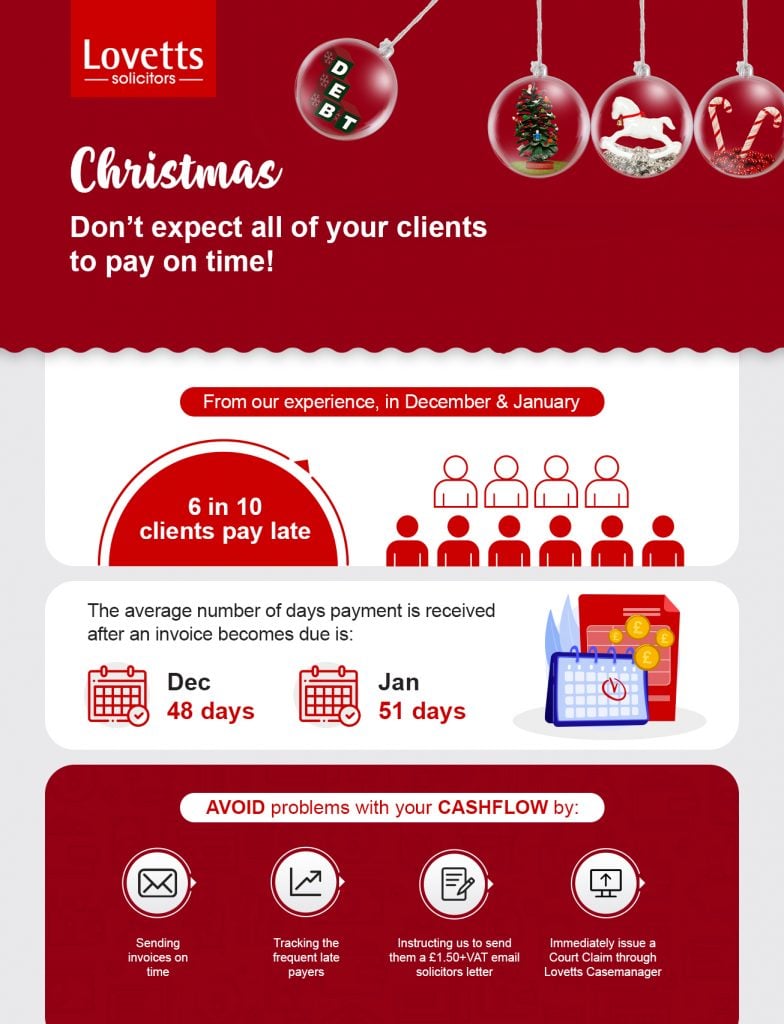
It’s no secret that business slows down during the Christmas period. Offices are closed, staff are away, and paying invoices can become the furthest thing from people’s minds. This is particularly true this year, when the economic fallout from the Covid-19 crisis and subsequent period of lockdown continues to have a monumental impact on our social, psychological, and economic well-being.
But for businesses – particularly SMEs – cashflow remains imperative, and so it can be useful to head-off any festive payment slowdowns before they occur. Here, we look at six steps you can take to help protect your cashflow this Christmas:
1. Check that your customer has received the invoice
A common reason for late payment is a customer claiming that they have not received your invoice. By remaining diligent and following up on sent invoices in plenty of time, you leave the option open to resend the correspondence BEFORE the Christmas and New Year’s break.
2. Offer incentives to customers who pay in advance
Christmas is the perfect time of year to show appreciation for customers who pay on time! You could include an option on end of year invoices for prompt payers to receive a small discount.
3. Chase up overdue invoices immediately
Obviously it goes without saying that as soon as invoices fall due you should chase them up. You are entitled to this payment. Customers will often have a lot to wrap-up as they approach year end, and a small nudge can be enough to remind them of what their priorities should be.
4. Target customers with a history of late payments
Do not be afraid to be robust, especially with customers who are consistently making late payments. Companies will often have a handful of customers who are responsible for the majority of late payments, so targeting these people early is a good exercise in helping to protect cashflow.
5. Send a Letter Before Action
On average the Lovetts Letter Before Action (LBA) is effective in 86% of all cases, with no further action being required. At just £1.50 for an email version, it’s a fast, efficient way to stay on top of outstanding payments.
6. Issue Court Proceedings
Whether it is approaching Christmas or not, if pre-action correspondence has been ignored then again, you are entitled to this payment, and it is time to consider legal action. The first step here is issuing a court claim, and you can find out more here.
It’s undoubtedly been a difficult year, and of course we all operate with empathy in the current climate in understanding that many businesses are going through a tough time right now. But this understanding must work both ways, and those reading this will be well aware of how important cashflow is to their own company’s survival even in the most productive of years, let alone in the midst of a global pandemic.
Even in normal times, payment on invoices that would usually be dealt with in a timely fashion is often pushed back significantly at this time of year. In fact, Lovetts research shows that the average number of days payment is received after an invoice falls due, rises to 48 days in December, and 51 days in January.
Therefore, what a lot of the above advice boils down to, is that it’s important to be particularly proactive in your credit control and debt recovery activities prior to the onset of the festive period. We hope you found these six steps useful, and to find out more about how Lovetts can get you started in your debt recovery efforts today click here.
Lovetts Solicitors has launched a direct debt payments platform, securely accessible via the firm’s website. The new portal enables account-to-account payments from debtors to creditors online, removing the need for intermediary transfers. It encourages faster payments to creditors, while providing debtors with greater transparency, more information, and less of the stress traditionally associated with the debt collection process.
Powered by payment processing solution Banked, the new Lovetts platform allows debtors to sign-in securely using their case number and solicitor letter reference. From there, users simply authorise their bank to make payment directly to the creditor company, via either their online or mobile banking app.
As a technology-driven law firm, Lovetts already employs an online sign-up process, as well as its own bespoke case management software, CaseManager, which allows clients to track and manage cases directly online. The new direct debt payments platform also facilitates the real-time transfer of funds without a holding period, which can be particularly advantageous for creditor companies attempting to manage cashflow.
“We wanted to take the existing online services we offer, and expand them to create a complete online debt collections process from start to finish,” said Andrew Dancy, IT Director for Lovetts. “Banked is one of the best new ideas to come out of Open Banking that we’ve seen so far, and of course especially as a law firm, the strong security measures that it allows us to build in are hugely important when considering any kind of online payment mechanism. By interfacing our existing technology with this API, we’ve been able to facilitate more seamless payments, and in addition to reducing costs that can be a weight off the mind of debtors and creditors alike.”
The Banked solution provides a 90% reduction in processing fees, and additionally as a Strong Customer Authentication (SCA) channel, a 96% reduction in fraud. It’s part of the Online Banking initiative, a government-led directive set-up by the Competition and Markets Authority (CMA) in 2018 and regulated by the Financial Conduct Authority (FCA) and European equivalents, to grant users greater control over their financial interactions online.
Brad Goodall, Co-founder & CEO of Banked, said: “Handling highly sensitive financial information for their clients, Lovetts new direct debt payments platform requires a partner that can guarantee them the highest levels of security and data privacy. We’re looking forward to working with Lovetts as their trusted payments partner of choice as well as the opportunity to bring account to account payments into a new vertical for Banked.”
Lovetts has become an official partner to ARMA – the Association of Residential Managing Agents, an organisation that promotes high standards of leasehold management across England and Wales by providing advice, training and guidance to its members.
(more…)You get to the end of your credit control procedure and you still have some unpaid accounts, so, what are the options?
Is your customer giving reasons for not paying?
Sometimes things go wrong or your customer has a complaint, rightly or wrongly. So, the first question is whether or not they have a genuine complaint.
There is a good reason
If your customer has a good point and you can’t sort this out through negotiation you should consider Alternative Dispute Resolution (ADR), mediation being the most common form of ADR.
There isn’t a good reason or the debtor doesn’t respond
If your customer is unresponsive or the points raised are not good reasons for failing to pay, your options are as follows:
• Letter before action
You will need to start with a letter before action. This is a letter telling your customer that the next step will be court proceedings, if the matter is not resolved. Court rules give details of the information that should be given in the letter. From October, there will be special requirements for a letter before claim to an individual, including a sole trader.
• Court action and default judgment
If you start an action and your customer doesn’t file a defence you will be able to get judgment in default of defence.
• Court action plus summary judgment
Your customer may file a defence but the reasons they give for not paying may not be good ones. In this case, you can make an application for the court to decide the case on paper (an application for summary judgment). An application for summary judgment is quicker and cheaper than going to full trial.
• A defence is filed
Sometimes an unresponsive debtor will file a defence that raises issues which can’t be dealt with by summary judgment and would need to go to trial. In this case you should again consider ADR, if you can’t resolve this through negotiation.
• Insolvency
Provided the debt is undisputed, then, as an alternative to a debt claim you could consider the threat of insolvency. If the debtor is a company, the debt just needs to be at least £750 and you don’t have to serve a statutory demand. So, the threat of insolvency proceedings can be very effective. Click here for more information.
For an individual, the debt needs to be at least £5,000, so insolvency is only an option for higher debts.
Is chasing late payments getting in the way of your other business priorities?
Our handy free guide will provide you with 10 tips and insights to help you reduce those issues. DOWNLOAD FREE